
02
ERP & CRM Systems
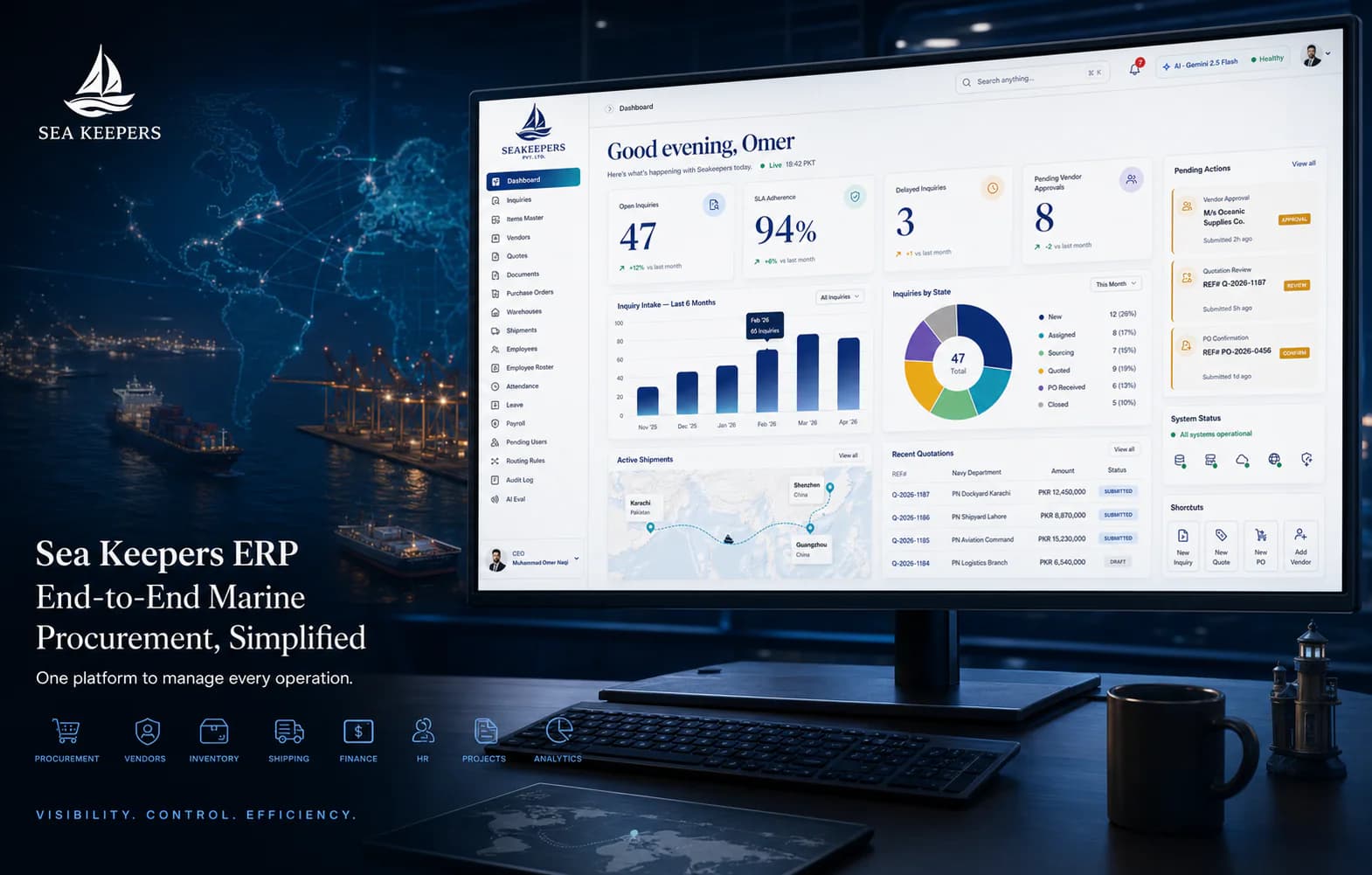
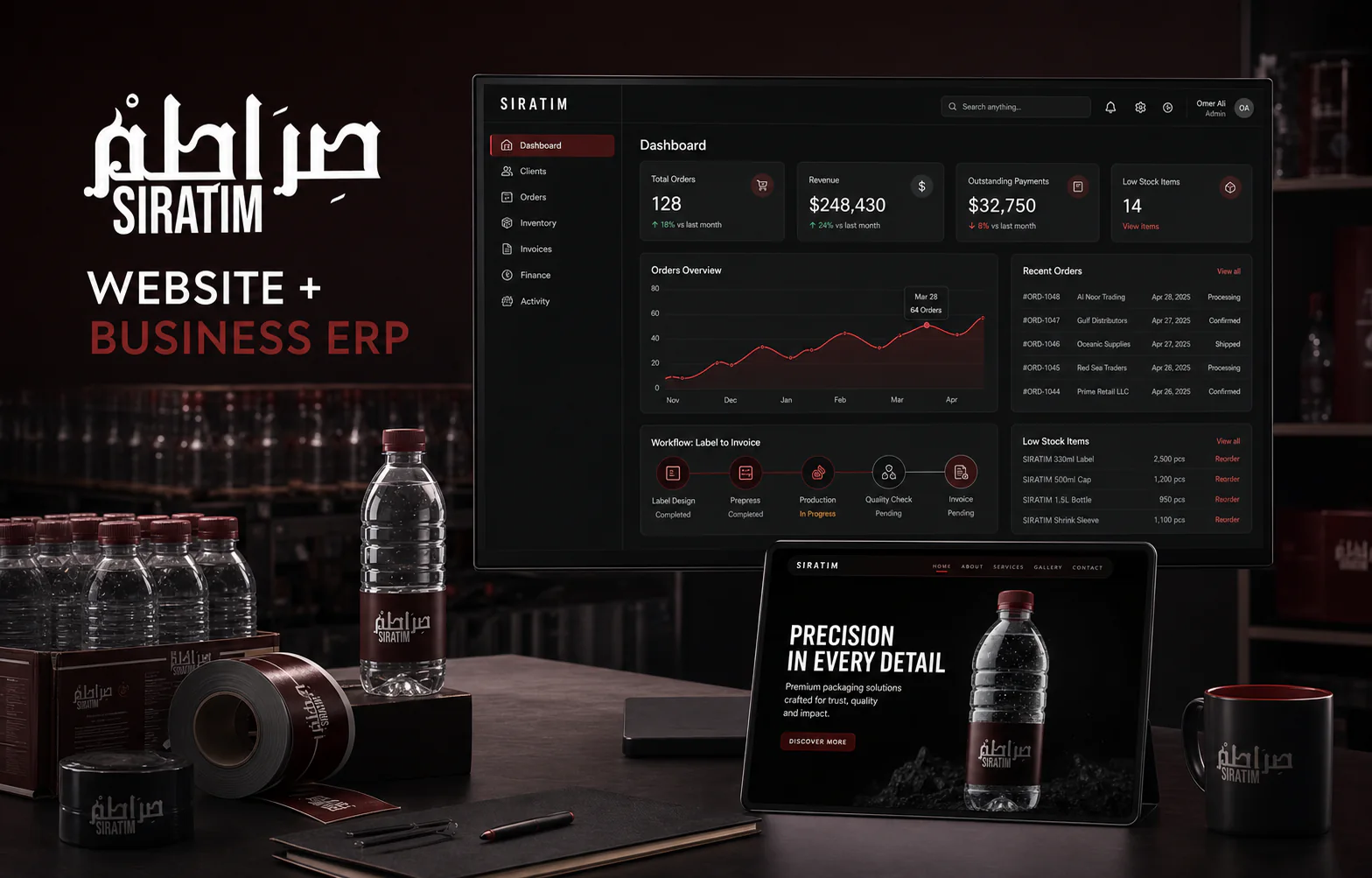
Custom ERP and CRM platforms that replace spreadsheet chaos with one source of truth — quotations, purchasing, inventory, HR and reporting, tailored to how your business actually runs.
Short answer
A2Z Global builds custom ERP and CRM systems that connect sales, inventory, purchasing, finance and customer records in one place, designed around how your business already works. Systems are built for local tax and invoicing rules — FBR in Pakistan, VAT in the UAE and UK, ZATCA e-invoicing in Saudi Arabia — and delivered in phases, one working module at a time.
Key takeaways
- The order modules are built in matters more than which modules you choose.
- Clean master data — customers, products, suppliers — is the foundation every module depends on.
- Invoicing has to be designed for the country's tax and e-invoicing rules from the start, not adapted later.
- Delivery is phased: one module in daily use before the next begins.
Custom ERP, or off the shelf?
Packaged ERP is cheaper to start and right for standard processes. Custom ERP pays back when your workflow is unusual, spans systems no product connects, or when per-user licences have become the biggest line in the budget. Custom ERP versus off-the-shelf goes through the comparison in detail.
| Module | Replaces | Usually built when |
|---|---|---|
| Inventory | Stock registers and spreadsheet counts | Stock accuracy is a daily argument |
| Sales & quotations | Quotes in Word and orders on WhatsApp | Orders get lost or priced inconsistently |
| Purchasing | Emailed purchase orders | Supplier costs and receipts do not reconcile |
| Finance & invoicing | Re-typing into accounting software | Operational records are already reliable |
| CRM | Leads in notebooks and personal phones | Follow-ups are missed as the team grows |
| HR & payroll inputs | Attendance registers | Headcount makes manual payroll error-prone |
| Reporting | Management asking people for numbers | Last — once the data underneath is trusted |
Who it is for
- Trading, distribution and manufacturing businesses outgrowing Excel.
- Multi-branch operations where stock and pricing have to stay consistent — see running multi-branch operations on one system.
- Sales teams running on WhatsApp who are losing follow-ups — the case in CRM for sales teams.
- Companies whose accounting software and operations never agree at month end.
How an ERP project runs
Map the operation
We sit with the people who do the work and document how it actually runs, including the exceptions.
Choose the first module
The one that removes the most manual hours — not the one that is logically first.
Clean and migrate master data
Customers, products, suppliers and opening balances, rehearsed before go-live.
Pilot with real work
The module goes into daily use with live transactions before anything else is added.
Expand and integrate
Adjacent modules, then accounting integration, then reporting on data that is already trusted.
/Markets
ERP & CRM Systems in Pakistan, the UAE, Saudi Arabia, the USA and the UK
Tax, e-invoicing, payments and language change from one country to the next. Choose yours to see what that means for this service.
What you get
- Custom ERP/CRM modules
- Role-based portals & dashboards
- Third-party integrations (accounting, email, logistics)
- Data migration & training
Common questions
Can you extend our existing ERP?
Yes — we build modules and integrations on top of existing systems, or modernize them incrementally without a risky big-bang rewrite.
How is data migrated?
We script and rehearse every migration on staging, reconcile counts, and cut over on a weekend with rollback ready.
How much does a custom ERP cost?
It depends on modules, users, integrations and data migration, so you get a fixed written quote after discovery rather than a guessed range. Phasing the build means the first module starts paying for the rest.
Can the ERP handle VAT and e-invoicing?
Yes, and it is designed for the country you operate in: FBR requirements in Pakistan, 5% VAT in the UAE, 15% VAT and ZATCA e-invoicing in Saudi Arabia, and Making Tax Digital through your accounting package in the UK.
Can it connect to our accounting software?
Usually, through the package's API — QuickBooks, Xero, Zoho Books, Sage and others. We draw the boundary first so the ledger lives in one place. ERP and accounting integration explains the approach.
How long does an ERP take?
The first module is in daily use long before the whole system is finished. A phased project delivers working software early instead of going quiet for months.
Related reading
All articlesCRM Developers in Pakistan: Choosing One by City
How to choose a CRM developer in Karachi, Lahore or Islamabad — what a CRM has to do for each city's kind of sales team, the questions that expose a developer who has never built one, and how to run the project from another city.
ERP Developers in Pakistan: Karachi, Lahore, Islamabad and the Rest
How to choose an ERP developer in Pakistan by city — what Karachi, Lahore and Islamabad teams are practised at, what Faisalabad, Sialkot, Gujranwala, Multan and Peshawar businesses need instead, and the competence checks that matter more than location.
Hiring a Software Developer in Pakistan: Karachi, Lahore and Islamabad Compared
What actually differs when you hire a software developer in Karachi, Lahore or Islamabad — the kind of work each city does, how to meet and manage a team in another city, and the checks that matter more than the postcode.
Manual Systems vs ERP: What Actually Changes in a Working Day
A side-by-side look at five everyday workflows — sales orders, stock, invoicing, month-end and customer queries — run manually and run on a system, including what an ERP does not fix.